The Mysteries of the Temple of Heaven: Ancient Chinese Cosmic Wisdom Hidden in Beijing’s Sacred Altar
What makes the Temple of Heaven one of China’s most iconic landmarks? Built more than 600 years ago, the Hall of Prayer for Good Harvests holds many little-known secrets about how ancient Chinese people understood the universe.
Located southeast along Beijing’s Central Axis, the Temple of Heaven complex covers 2.73 million square metres — roughly four times the size of the Forbidden City. This was not a palace for emperors to govern the country. For over six centuries, it stood as a solemn sacred site. It was where emperors of the Ming and Qing dynasties prayed and communicated with heaven.
Why was the Temple of Heaven built?
Construction began in 1420, the 18th year of the Ming Yongle reign. When the Yongle Emperor moved the capital to Beijing, he ordered this complex modelled after an older temple in Nanjing.
Originally named the Temple of Heaven and Earth, it hosted ceremonies for worshipping both heaven and earth at the same location.
In 1530, the Jiajing Emperor followed ancient rituals and separated heaven worshipping and earth worshipping ceremonies. The Circular Mound Altar was built in the southern suburbs for heaven worship. The Square Altar (today’s Ditan Park / Temple of Earth) was built in the northern suburbs for earth worship. From then on, the site officially became known as the Temple of Heaven.
Why is the Temple of Heaven four times larger than the Forbidden City, the emperor’s own home? In ancient times, emperors called themselves “Sons of Heaven”. The place for honouring heaven needed to be grander than the imperial residence, to show deep respect for heaven.
Two major state scale ceremonies were held here every year:
- In the first lunar month, rites were held at the Altar of Prayer for Grain, praying for rich harvests.
- On the Winter Solstice, grand worship ceremonies took place at the Circular Mound Altar, praying for peace and stability across the country.
Li Weiwei, researcher from Beijing Institute of Archaeology, commented: “The Temple of Heaven shows ancient Chinese people’s understanding of the cosmos, nature, and the relationship between humans and the natural world.”
Hall of Prayer for Good Harvests: Cosmic symbolism inside the building
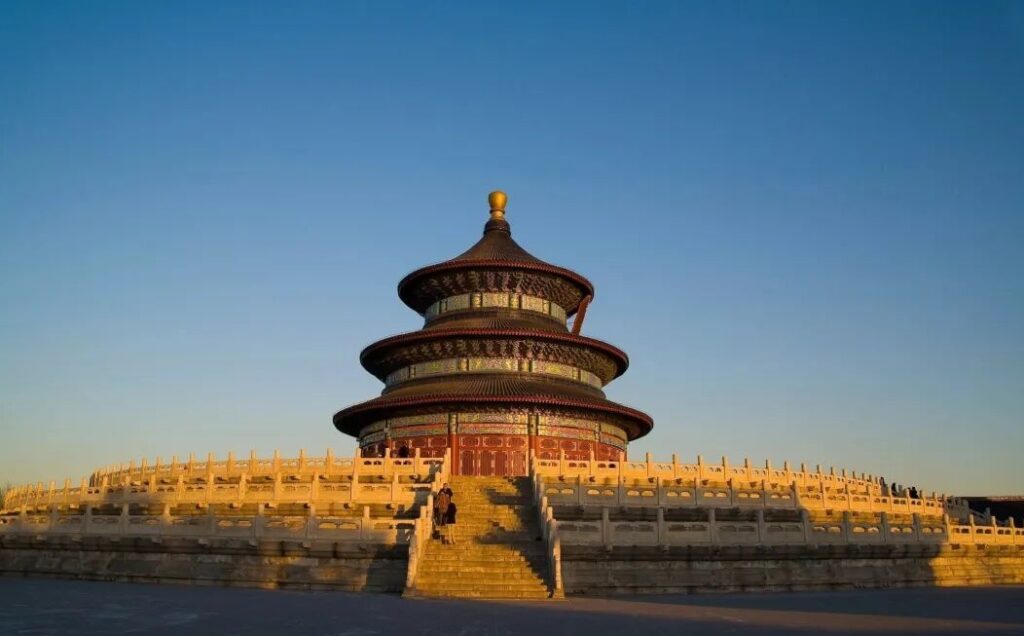
No visit to the Temple of Heaven is complete without seeing the Hall of Prayer for Good Harvests. This three tiered circular building with blue glazed roof tiles, red pillars and a gilded top is the symbol of the whole site.
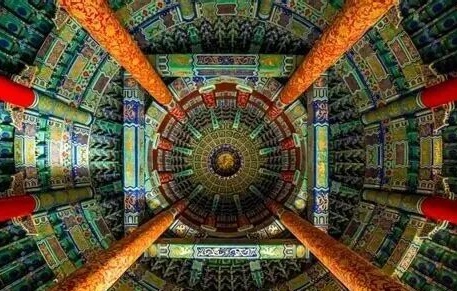
Its beauty is not only on the surface. The arrangement of wooden pillars inside carries deep symbolic meaning about seasons and stars.
The hall has no large horizontal beams. The entire heavy roof is supported by interlocking nanmu wooden pillars and brackets. Each group of pillars stands for something:
- Four central dragon well pillars: represent the four seasons: spring, summer, autumn and winter.
- Twelve inner golden pillars: stand for the twelve months of the year.
- Twelve outer eave pillars: represent the twelve two hour time periods in one traditional Chinese day.
The inner and outer rings add up to 24 pillars, symbolising the 24 Solar Terms. Together with the four central pillars, there are 28 pillars, representing the Twenty Eight Constellations in traditional Chinese astronomy. Adding eight extra supporting pillars under the roof brings the total to 36, referring to the Thirty Six Heavenly Spirits from ancient Chinese cosmology.
Seasons, months, solar terms and star constellations are all represented within one single building — a special ancient Chinese way of seeing the universe.
Fun fact: In the Ming Dynasty, the three roof layers had different colours. The top blue stood for heaven, middle yellow for earth, and bottom green for all living things. During the Qianlong reign of the Qing Dynasty, all three layers were changed to uniform deep blue glazed tiles to symbolise the sky.
Circular Mound Altar & the Heavenly Centre Stone: the magic of number nine
Walk south and you will reach the Circular Mound Altar, an open air stone platform where emperors offered sacrifices to heaven on Winter Solstice. Almost every detail follows the number nine, a sacred number representing heaven.
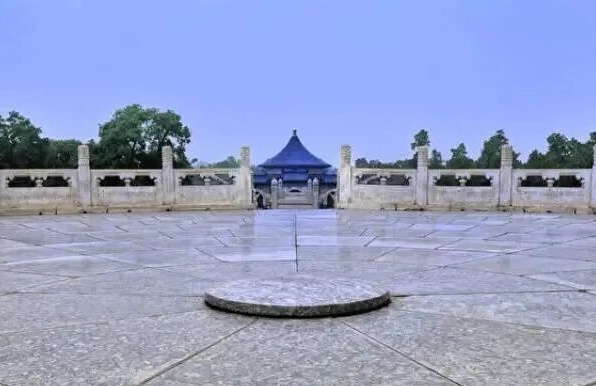
The altar has three levels. Each level is paved with concentric stone rings, nine rings in total, symbolising the Nine Heavens in Chinese mythology.
Right in the very centre lies the round Heavenly Centre Stone. Ancient people believed standing on this stone allowed humans to communicate with heaven. Counting outwards from the centre: the first ring has 9 stones, the second ring 18 stones, and so on. The outermost ninth ring has 81 stones (9 multiplied by 9).
The idea of “Heaven is round, Earth is square”
Many parts of the Temple of Heaven reflect the ancient belief: Heaven is round, Earth is square.
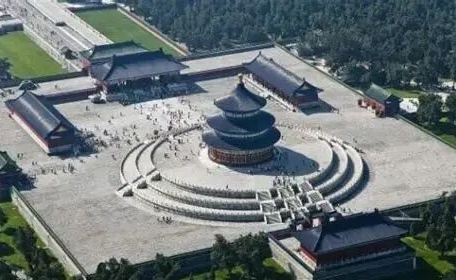
- Major buildings including the Hall of Prayer for Good Harvests, Imperial Vault of Heaven and Circular Mound Altar are all circular in shape, symbolising round heaven.
- Blue glazed tiles cover the main roofs to represent the blue sky.
- The outer surrounding wall is round on the northern end and square on the southern end, visualising this ancient world-view.
Ancient acoustic wonders: Echo Wall and Three Echo Stones
The Temple of Heaven preserves amazing architectural tricks that still surprise modern visitors. The most famous is the Echo Wall.
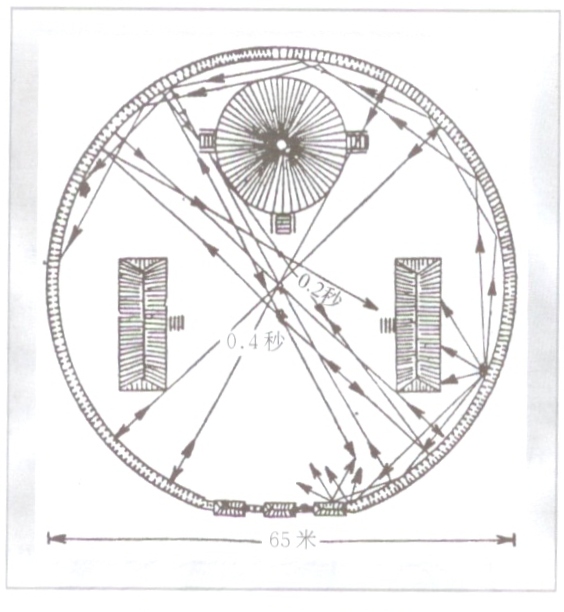
It is the circular outer wall of the Imperial Vault of Heaven, finished in 1530. It is 3.72 metres high, 0.9 metres thick, with a diameter of 61.5 metres.
Two people can stand at opposite ends close to the wall. One person whispers softly against the wall, and their voice travels along the curved wall, so the other person hundreds of feet away can hear it clearly — almost like an ancient telephone.
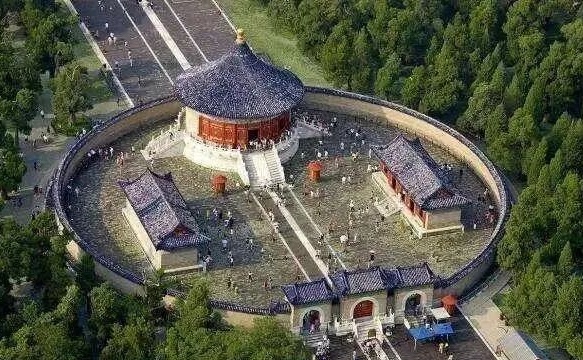
This effect comes from superb craftsmanship. Bricks were specially made in Linqing, Shandong province. Clay was soaked and filtered to get extremely fine soil. Every brick surface was carefully polished. Bricks fit tightly together with almost no gaps. Blue glazed tiles on the top of the wall prevent sound energy from escaping, so sound waves travel along the curved wall.
Not far away in front of the Imperial Vault of Heaven are the Three Echo Stones. Clap your hands standing on the first stone slab and you hear one echo. Stand on the second or third slab and you will hear two or three echoes respectively. The loud sounding acoustic effect on the Heavenly Centre Stone is also created through sound reflection.
Who built the Temple of Heaven?
Historical records name Kuai Xiang, a brilliant Ming dynasty master carpenter known as “Living Lu Ban”, as the main construction supervisor. Some sources say the original site location was chosen by feng shui expert Zeng Congzheng.
However, the Temple of Heaven we see today is not exactly the original building. Kuai Xiang first built a square shaped Great Sacrificial Hall for joint heaven and earth worship. The present day complex was rebuilt and expanded many times across Ming and Qing dynasties, achieved by generations of unknown craftsmen.
World-recognised cultural treasure
In 1998, the Temple of Heaven was inscribed on the UNESCO World Heritage List. Its official description notes it powerfully illustrates a cosmological concept that shaped one of the world’s great civilisations.
In 2011, oral legends related to the Temple of Heaven were listed as national intangible cultural heritage. In July 2024, the Temple of Heaven was re affirmed as a core component of the World Heritage site “Beijing Central Axis — a masterpiece of ancient Chinese urban planning”.
For six centuries, the Temple of Heaven carries ancient Chinese respect for heaven and nature. It embodies the traditional philosophy: Harmony between human and nature, following the ways of nature. Standing on this sacred ground, where emperors once connected with heaven, visitors can still feel its quiet, timeless power.